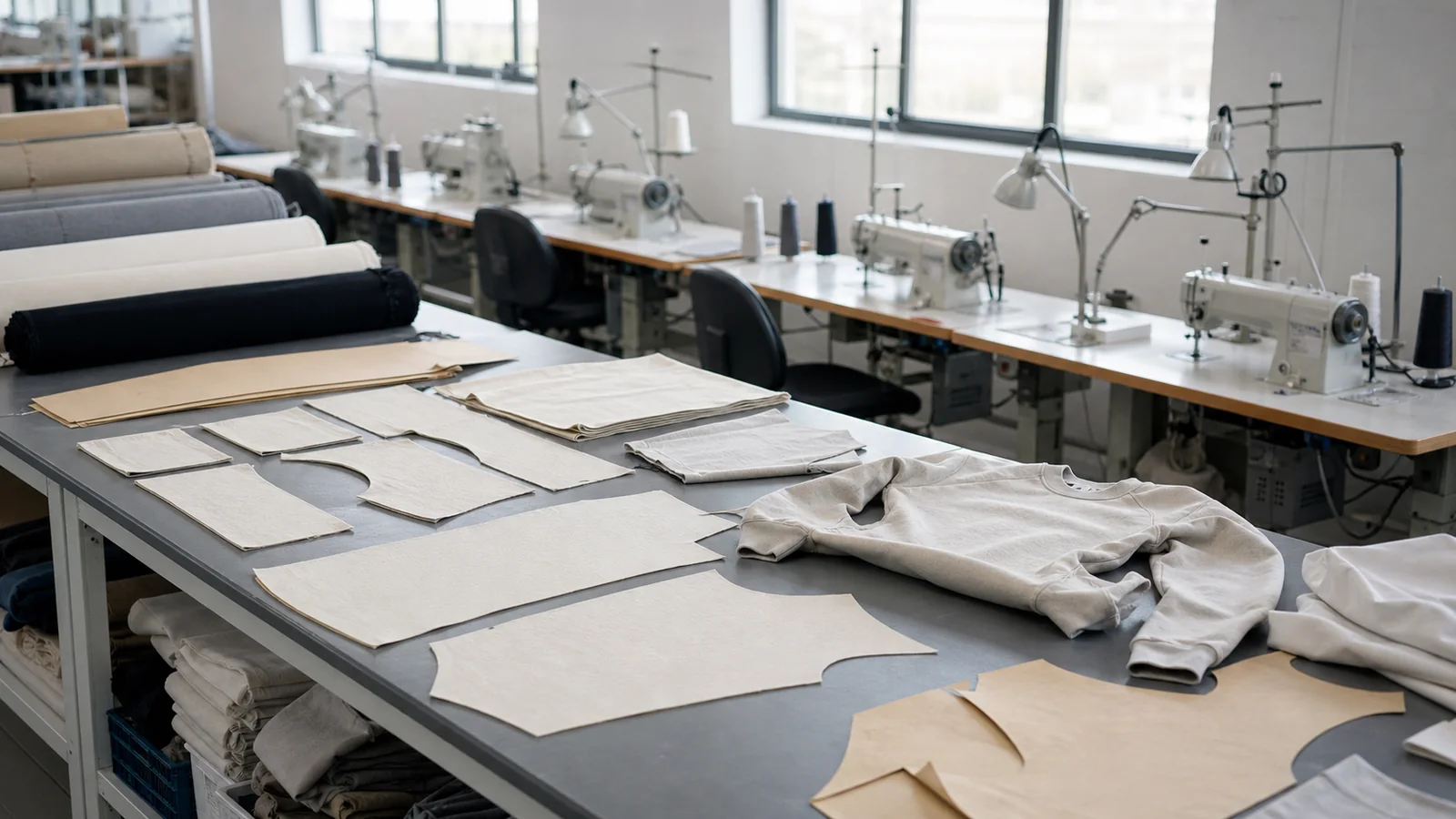
Garment manufacturing converts approved materials and technical requirements into finished apparel. The process includes product engineering, pattern development, sampling, material approval, cutting, sewing, decoration, finishing, inspection, packing, and shipment. A reliable outcome depends on controlled handoffs, not on sewing alone.
From product brief to production standard
- Define the product: document design, measurements, materials, construction, colors, artwork, labels, packing, care, and target market requirements.
- Develop the pattern and sample: test fit, balance, construction, fabric behavior, decoration, and manufacturability.
- Approve materials and components: control fabric, shade, trims, labels, thread, decoration, and packaging.
- Prepare bulk production: finalize grading, marker, consumption, cut plan, work instructions, quality points, and schedule.
- Manufacture and finish: cut, bundle, sew, decorate, wash or finish where required, press, inspect, and pack.
- Authorize shipment: reconcile quantity and packing, review tests and inspections, resolve deviations, and release the goods.
Decisions that shape cost, quality, and lead time
Control the product definition
A tech pack should make decisions visible: construction, points of measure, tolerances, materials, artwork, labels, packing, revision status, and approvals.
Resolve risk before bulk
Prototype, fit, size-set, decoration, wash, and pre-production samples answer different questions. Name the purpose and approval status of each sample.
Trace the real constraint
The limiting minimum may come from fabric, dyeing, trims, decoration setup, color allocation, or efficient line planning—not only the sewing factory.
Compare against controlled standards
Measurements, workmanship, shade, decoration, labels, testing, quantity, and packing should be checked against approved references.
An approved sample needs a status
A fit-approved sample may not approve fabric shade or decoration. A pre-production sample should state which materials and details it controls, and any exception should be recorded before the order moves forward.
Fabric and pattern must be developed together
Fabric weight, stretch, recovery, shrinkage, skew, thickness, drape, and finish influence the pattern, seam construction, marker yield, decoration, and finished measurements. A pattern approved in one fabric may not perform correctly after a later material substitution.
Before cutting, production fabric should be inspected, shade grouped where necessary, relaxed under an agreed procedure, and compared with the approved standard. Shrinkage information must reach pattern and marker planning. The cost of discovering dimensional change after sewing is far higher than testing it during development.
Garment development and sourcing guides
Private label and Turkey production
Private-label projects add labels, trims, packaging, artwork, and brand presentation to the technical product. These components have their own specifications, proofs, minimums, lead times, and regulatory requirements. Plan them before the final sample instead of treating them as packing-stage additions.
For Turkey-specific production, read the guides to clothing manufacturing in Istanbul, private-label clothing in Turkey, and streetwear production in Turkey. Buyers seeking practical apparel production coordination can also review Istanbul-based apparel production.
Continue to Fabrics for material specifications and Quality & Testing for verification.
Process background: the International Labour Organization’s guidance on garment supply-chain operations and occupational safety, alongside the technical product-development sources recorded in the project research file.