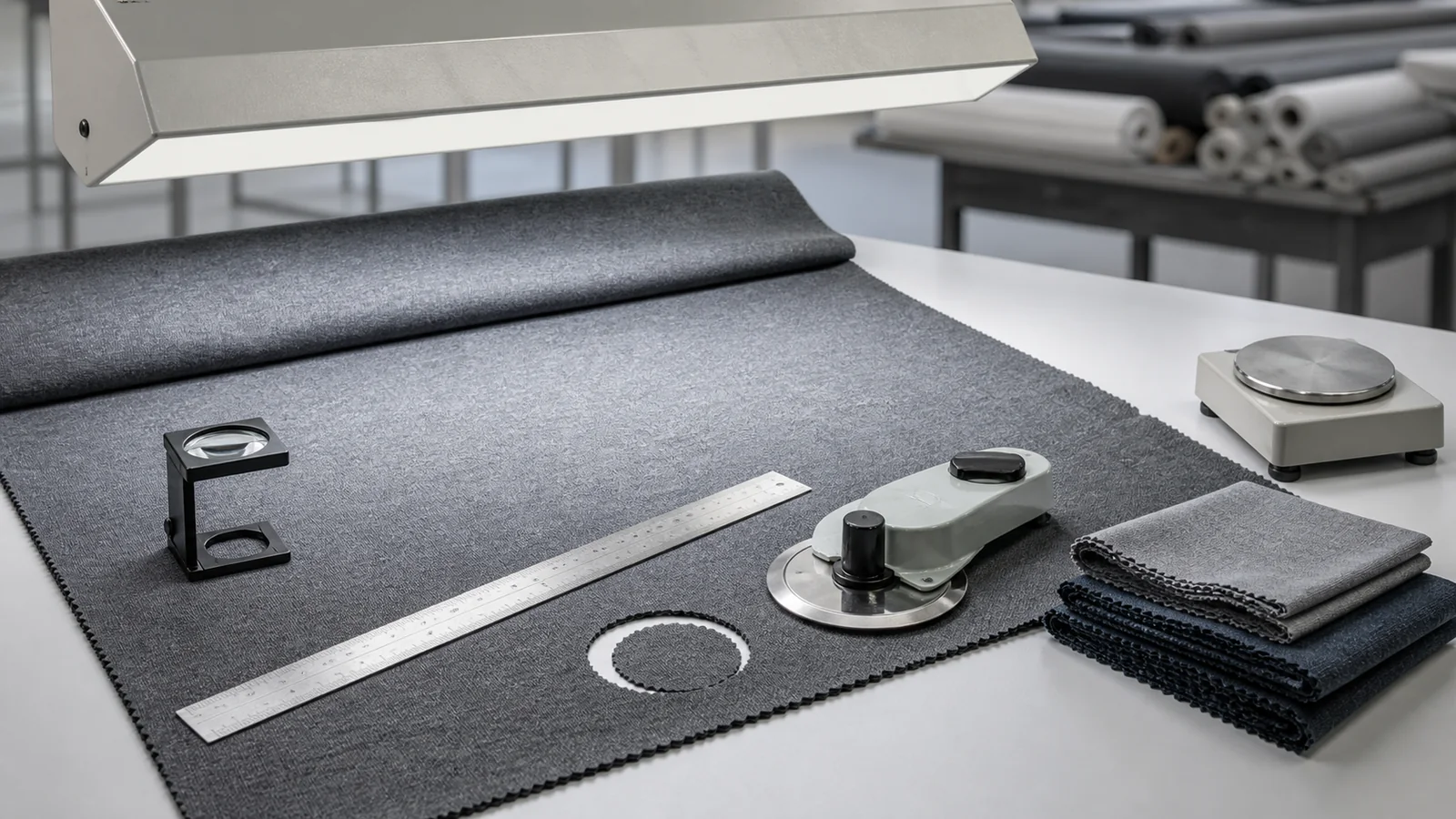
Textile quality testing uses defined methods to measure whether materials and garments meet agreed requirements. Quality control is broader: it includes specifications, approvals, process checks, laboratory tests, inspections, defect decisions, and records. Testing supports a decision only when the method, specimen, conditioning, result, and acceptance criteria are clear.
Specification, test method, and tolerance
A statement such as “good colorfastness” is not an actionable requirement. A usable specification identifies the property, the applicable method and version, the preparation or care cycle, the reporting scale or units, and the pass criterion. Buyer requirements may draw on ISO, AATCC, ASTM, national, retailer, or internally agreed methods.
Shrinkage, growth, and skew
Results depend on the laundering, drying, conditioning, marking, and calculation procedure. Method and cycle must accompany the percentage.
Pilling and appearance
Different apparatus and assessment procedures exist. A pilling grade is meaningful only with the named method and exposure.
Fastness by exposure
Washing, rubbing, perspiration, light, and other exposures answer different questions and can require different test setups.
Strength and seam behavior
Tensile, tear, bursting, seam strength, seam slippage, and stretch tests must suit the fabric and garment structure.
Plan tests around product risk
A lightweight printed T-shirt, a brushed fleece hoodie, a stretch legging, and a woven trouser should not receive identical test plans. Fiber, construction, finish, color, decoration, care instructions, end use, target market, and buyer protocol determine what needs verification.
For example, an oversized cotton T-shirt may need close attention to dimensional change, skew, neck-rib recovery, spirality, shade, and print durability. A dark fleece garment may add pilling, crocking, and shade-transfer risk. A stretch product may need recovery and seam-extension controls. A risk-based plan uses fewer irrelevant tests and gives more attention to likely failure modes.
One passing sample does not control bulk
Development testing shows whether an approved construction can meet requirements. Production controls still need representative sampling, lot traceability, shade management, measurements, and workmanship inspection.
Laboratory testing and garment inspection do different jobs
Laboratory tests measure defined physical or chemical properties under controlled conditions. Garment inspection checks visible defects, measurements, workmanship, labels, decoration, packing, quantities, and comparison with the approved sample. Neither replaces the other.
Inspection terminology should be agreed before an order. The parties need to define what counts as critical, major, and minor, how units are selected, what acceptance plan applies, and who decides on repair, replacement, concession, or rejection. A familiar sampling phrase should not be used as if it guarantees every unit is defect-free.
A practical quality-control sequence
- Define end use, legal or buyer obligations, care method, and product-specific risks.
- Convert the brief into measurable material, garment, decoration, label, and packing requirements.
- Name the test methods, versions, units, cycles, and pass criteria before testing.
- Approve fabric, color, fit, construction, and decoration standards before bulk release.
- Inspect representative production, review laboratory reports, record deviations, and authorize shipment.
For construction context, visit Fabrics. For apparel controls, continue to Garment Manufacturing.
Standards references: ISO 105-C06 for colorfastness to domestic and commercial laundering, ISO 12945-1 for fabric pilling assessment, and the AATCC standards program.