What does MOQ mean in clothing manufacturing?
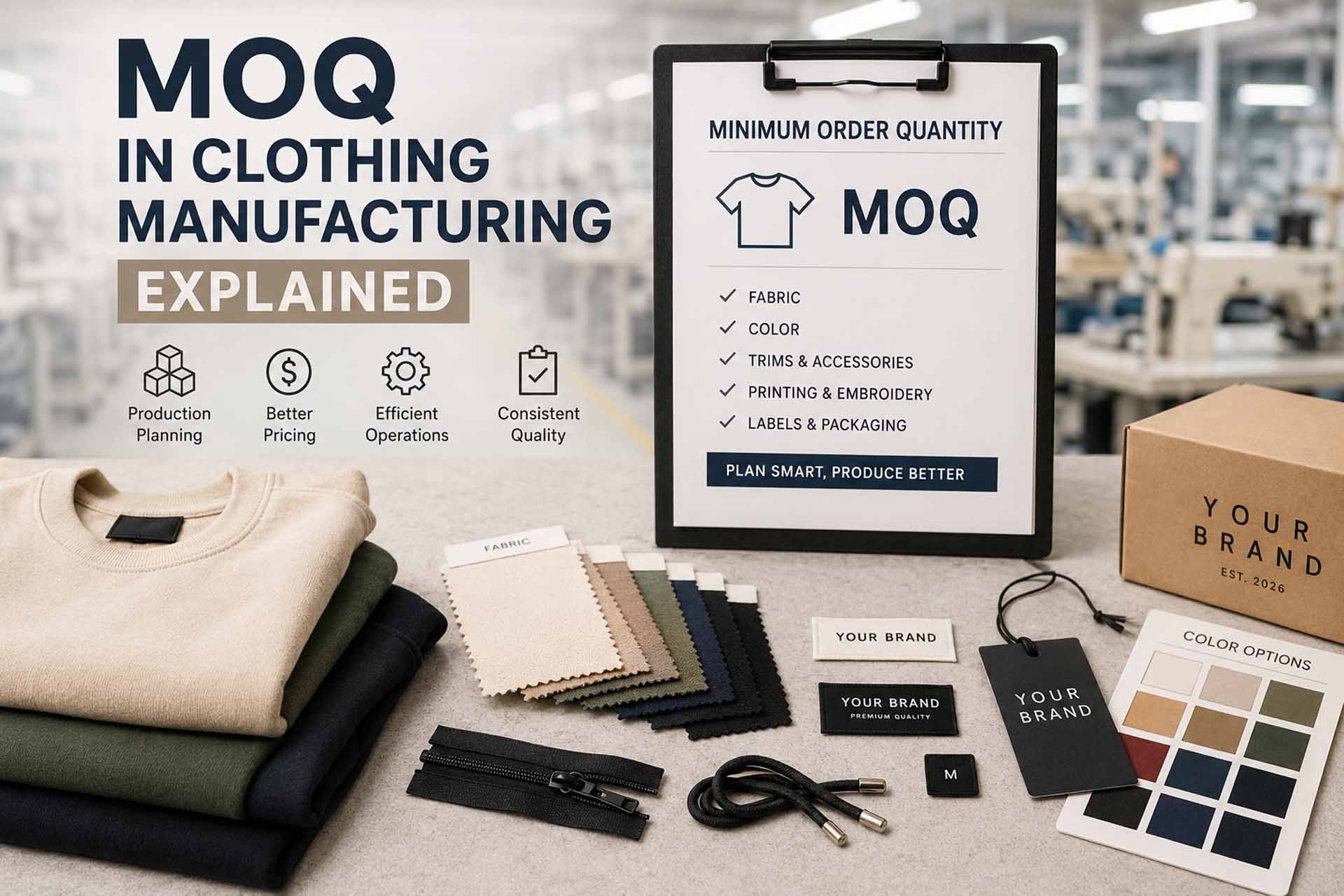
MOQ means minimum order quantity. In clothing manufacturing, it is the smallest quantity a factory or supplier can produce efficiently for a specific garment, fabric, color, label, trim, or decoration method.
MOQ clothing manufacturing is one of the first topics new fashion brands meet when speaking with factories. A brand may want a small test order, while the manufacturer may ask for 300, 500, or more. This is usually connected to how apparel production works, not only to factory preference.
Every order needs fabric sourcing, cutting, sewing, finishing, quality control, packing, and coordination with several suppliers. When the quantity is too small, the preparation cost becomes difficult to spread across the garments.
Why Do Clothing Manufacturers Set MOQs?
Factories set MOQs because production has setup costs. Before sewing begins, the team may need to prepare patterns, grade sizes, order fabric, cut markers, arrange trims, test prints, approve labels, schedule machines, and assign operators.
MOQ helps manufacturers protect:
- Production efficiency and sewing line scheduling
- Fabric and trim purchasing requirements
- Cutting room setup and size grading time
- Printing, embroidery, and washing minimums
- Quality control and packing workflow
Practical insight
MOQ is rarely one single number. A factory may accept one MOQ for basic private label T-shirts and a higher MOQ for custom-dyed fleece hoodies with embroidery, woven labels, and special packaging.
What Affects MOQ in Clothing Manufacturing?
MOQ changes depending on the product and the supply chain behind it. The same factory may quote different minimums for different garments, even for the same brand.
1. Fabric availability
Fabric is often the biggest MOQ driver. If the fabric is already available in the market, the minimum can be easier to manage. If the fabric must be knitted, dyed, brushed, washed, or finished specially, the minimum usually increases.
A stock black cotton jersey may be possible at a lower quantity than a custom 420 GSM fleece in a specific beige tone. Brands comparing materials should read our guide to fabric sourcing in Istanbul.
2. Color and dyeing
Color affects MOQ because dye houses often work with minimum dye lots. A brand asking for five colors in small quantities may face more complexity than a brand using two core colors across several styles.
3. Trims, labels, and packaging
Trims include drawcords, zippers, buttons, elastic, neck tape, woven labels, care labels, hang tags, poly bags, and packaging details. Custom trims can create their own MOQs, separate from the garment factory MOQ.
This is why private label planning should consider branding elements early. A custom label, zipper puller, or printed box can change the real minimum even when the garment itself is simple.
4. Printing and embroidery
Decoration also affects MOQ. Screen printing may require screens, color separation, ink setup, and curing tests. Embroidery requires digitizing, thread selection, stitch testing, and machine setup.
5. Style complexity and size range
A basic T-shirt is usually easier to produce than a lined jacket, cargo pant, technical activewear piece, or structured outerwear garment. More panels, seams, trims, and size grading can raise the practical production minimum.
Is MOQ Per Style, Per Color, or Per Fabric?
MOQ can be calculated in several ways. This is one of the most important questions to ask before sampling.
- Per style: the minimum applies to one garment design, such as one hoodie style.
- Per color: each color has its own minimum because fabric dyeing or cutting is separate.
- Per fabric: the same fabric can sometimes be used across multiple styles to reach a fabric minimum.
- Per production run: the factory may require a total quantity to schedule the line efficiently.
A brand may be able to produce 500 pieces total, but 500 pieces in one fabric and two colors is different from 500 pieces across ten colors, five styles, and several custom trims.
Low MOQ: Helpful, but Not Always Cheaper
Low MOQ can help startups test fit, demand, color response, and customer feedback before committing to larger stock. However, smaller quantities usually carry higher unit prices because setup time, sourcing work, decoration preparation, and QC are spread over fewer garments.
The best MOQ is not always the lowest number. The best MOQ is the quantity that lets your brand test the market while keeping quality, cost, and production reliability under control.
Practical MOQ Examples for Fashion Brands
Example: streetwear hoodie collection
A streetwear brand wants oversized hoodies in black, cream, and washed brown. The hoodie uses heavyweight fleece, custom drawcords, embroidery, inside neck labels, and branded hang tags. The MOQ may be affected by fleece availability, dyeing, rib matching, embroidery testing, and label minimums.
A more realistic first step may be two colors instead of three, one fabric across hoodie and sweatpants, and standard trims with custom labels. Brands planning this category can also read our guide to a streetwear manufacturer in Turkey.
Example: private label basics
A brand launching basic T-shirts may choose available cotton jersey, two core colors, simple neck labels, and one packaging format. This can be easier to produce than a collection with many colors, special washes, and different fabric weights. Read more about private label clothing in Turkey.
Why Turkey and Istanbul Matter for MOQ Planning
Turkey is important for MOQ clothing manufacturing because fabric suppliers, garment factories, label makers, printing workshops, embroidery teams, and packaging suppliers are often closely connected. In Istanbul, this can make sampling and production decisions faster, especially for brands that need flexible development.
Istanbul is also useful for European brands because communication, logistics, and lead times can be more manageable than working with distant supply chains. To understand the wider industry, read our guide to textile manufacturing in Turkey and our page on choosing a clothing manufacturer in Istanbul.
For brands that need professional support with production planning, sampling, sourcing, and bulk manufacturing, Istanbul Factory is a natural reference point for apparel production in Turkey.
How to Brief Your Manufacturer About MOQ
A clear brief helps the manufacturer give a realistic MOQ. Instead of asking only, “What is your MOQ?” share the product category, estimated quantity per style and color, fabric type, GSM, composition, color references, decoration method, label needs, packaging requirements, target price, and launch timeline.
When these details are clear, the factory can explain whether the MOQ comes from fabric, dyeing, cutting, trims, printing, or the production line. This makes the conversation more practical and avoids surprises after sampling.
Final Thoughts
MOQ clothing manufacturing is not just a number on a quote. It reflects fabric supply, production setup, decoration, branding, and quality control. Brands that understand MOQ can build cleaner collections, reduce unnecessary complexity, and negotiate with manufacturers more professionally.
FAQ: MOQ Clothing Manufacturing
What does MOQ mean in clothing manufacturing?
MOQ means minimum order quantity. It is the smallest production quantity a factory or supplier can accept for a garment, fabric, color, trim, label, or decoration process.
Why do clothing manufacturers have MOQs?
Manufacturers have MOQs because fabric sourcing, cutting, sewing setup, printing, embroidery, labeling, packaging, and quality control all require time and resources.
What affects MOQ in apparel production?
MOQ is affected by fabric availability, fabric color, dyeing, trims, labels, printing, embroidery, packaging, size range, style complexity, and production capacity.
Can a startup clothing brand start with low MOQ?
Yes, but low MOQ works best when the brand keeps the first collection focused, uses available fabrics, limits colors, avoids excessive custom trims, and confirms print or embroidery early.
Is MOQ per style or per color?
MOQ can be per style, per color, per fabric, or per production run. Brands should ask the manufacturer exactly how the MOQ is calculated before approving samples.