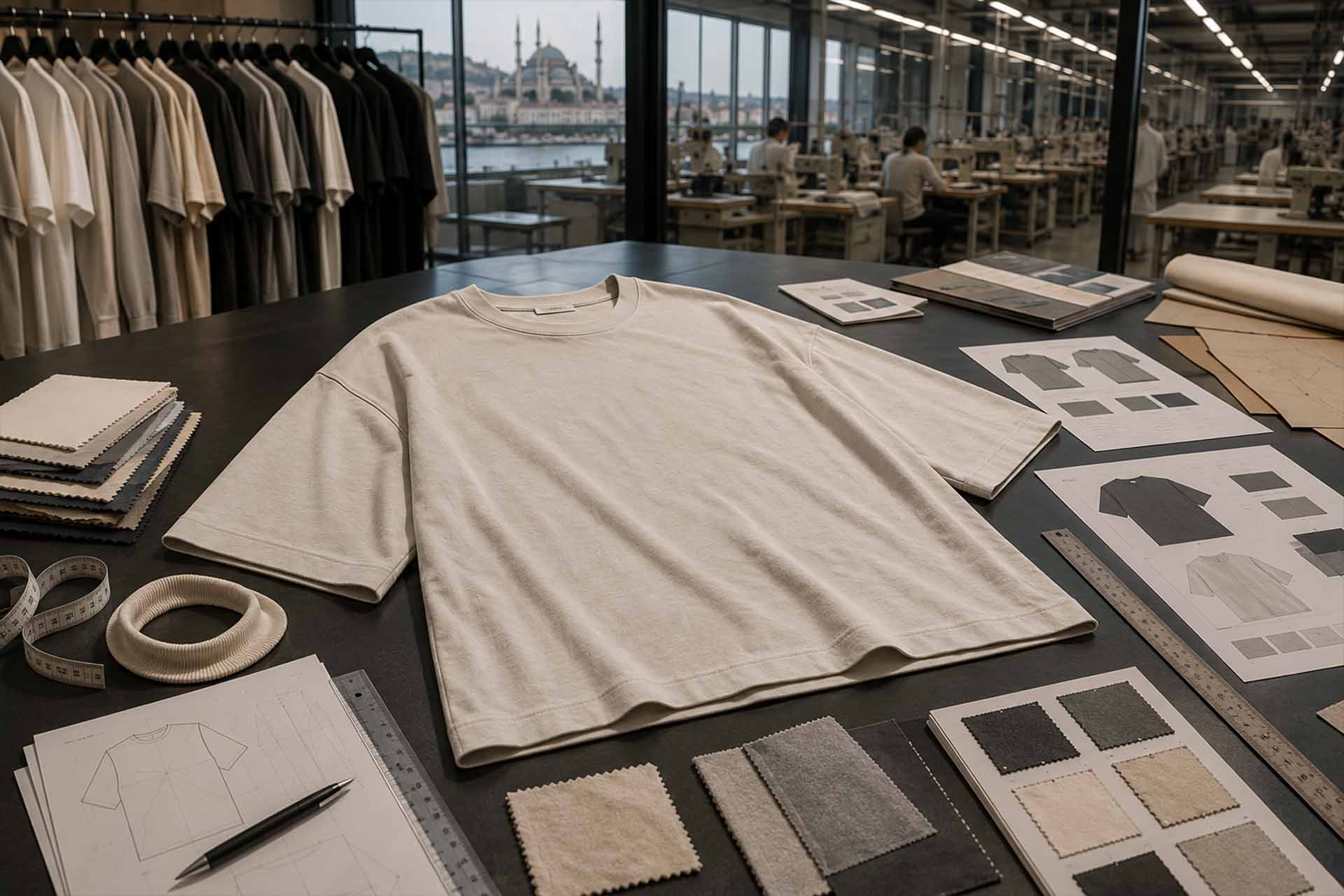
What is oversized t-shirt manufacturing?
Oversized t-shirt manufacturing is the process of developing T-shirts with intentionally relaxed proportions, including a wider body, dropped shoulders, adjusted sleeve shape, suitable fabric weight, stable neck rib, controlled shrinkage, and print placement that works with the larger silhouette.
Oversized t-shirt manufacturing looks simple from the outside. The garment has fewer components than a hoodie or jacket, but the fit is unforgiving. A small mistake in shoulder drop, body length, sleeve opening, or neck rib can make the product look cheap instead of premium.
For fashion brands, the oversized T-shirt is often a core streetwear product. It can carry bold graphics, minimalist branding, heavyweight cotton, garment washing, embroidery, and custom labels. The challenge is turning a relaxed concept into a consistent product that fits correctly after sampling, washing, packaging, and bulk production.
Fit Comes Before Everything
Oversized does not mean simply making a regular T-shirt larger. A proper oversized fit is designed with balance. The body width, shoulder position, sleeve length, sleeve opening, hem width, and garment length must work together.
Practical insight
Ask your manufacturer to evaluate the sample on body, not only on a table. Oversized garments can look correct when folded but lose balance when worn.
Shoulder Drop and Sleeve Shape
Shoulder drop is one of the most important details in oversized t-shirt manufacturing. It controls where the sleeve starts and how the garment sits across the upper body. A clean shoulder drop gives the product its relaxed streetwear shape without making it look sloppy.
What to check during sampling
- Does the shoulder drop look intentional?
- Does the sleeve fall cleanly without twisting?
- Is there enough comfort under the arm?
- Does the T-shirt keep its shape after washing?
For brands building streetwear collections, this fit work should be aligned with hoodies, sweatshirts, and sweatpants. You can read more in our guide to streetwear manufacturing in Turkey.
GSM and Fabric Selection
Fabric GSM affects how an oversized T-shirt hangs on the body. Lightweight jersey can feel soft and easy, but it may collapse if the pattern is very wide. Heavier jersey gives more structure, which is why many premium oversized T-shirts use cotton jersey in the 200 to 280 GSM range.
Fabric details to confirm
- GSM range and tolerance
- Composition, such as 100% cotton or cotton blend
- Hand feel, surface texture, and opacity
- Color availability and dyeing limitations
- Suitability for screen printing, embroidery, or washing
If your brand is still comparing fabric options, review our practical guide to fabric sourcing in Istanbul before moving into sampling.
Neck Rib and Neckline Control
The neckline is one of the first details customers notice. On an oversized T-shirt, the body may be relaxed, but the neck must stay controlled. A loose or stretched neckline can make even a heavyweight T-shirt feel low quality.
Neck rib should be selected based on fabric weight, desired neckline shape, and washing behavior. The rib must have enough recovery to return after wear, but it should not be so tight that it pulls the neckline or changes the fit.
A premium oversized T-shirt needs contrast: relaxed body proportions with disciplined construction details. The neck rib is where that discipline becomes visible.
Shrinkage and Washing Behavior
Shrinkage is a serious issue in oversized t-shirt manufacturing because the fit depends on planned proportions. If the fabric shrinks too much in length, the silhouette may become too boxy. If it shrinks across the width, the oversized feel may disappear.
Shrinkage should be checked before bulk cutting. Brands should request sample washing, fabric shrinkage data, and measurement review after wash. Pattern adjustments may be needed before the production pattern is approved.
Best practices before bulk production
- Test the fabric before final pattern approval
- Wash the sample and remeasure key points
- Confirm tolerance for chest, length, shoulder, and sleeve
- Review care label instructions honestly
Print Placement and Decoration
Print placement must be planned on the actual oversized pattern. A graphic that works on a standard T-shirt can look too small, too high, or badly centered on a wider body. This is especially important for large chest prints, back prints, sleeve graphics, and oversized logo placements.
Decoration choices should match the fabric. Heavy screen prints may work well on stable cotton jersey. Embroidery can add premium value, but dense embroidery on a lightweight oversized T-shirt may pull the fabric. Puff print, flock print, woven patches, and neck prints also need testing.
Why Istanbul and Turkey Matter for Oversized T-Shirt Production
Istanbul is practical for oversized T-shirt development because fabric sourcing, pattern making, sampling, cutting, sewing, printing, embroidery, labeling, and packaging can be coordinated inside a strong textile ecosystem. This matters when the product depends on small fit decisions and fast sample feedback.
For brands planning oversized streetwear production, Istanbul Factory is one example of a clothing manufacturer in Istanbul working with premium casualwear, streetwear, private label production, fabric sourcing, sampling, and export-focused garment manufacturing.
To understand the wider supply chain, read our guide to a clothing manufacturer in Istanbul. If your brand wants custom labels, packaging, and a complete product line, see our guide to private label clothing in Turkey.
How to Brief a Manufacturer for Oversized T-Shirts
A clear brief reduces sampling mistakes. Instead of asking for “an oversized tee,” describe the fit, body width, shoulder drop, sleeve length, GSM, fabric composition, neckline shape, print technique, label placement, packaging, and target customer.
Include these details in your production brief:
- Reference garment photos or a physical sample
- Target size chart and measurement tolerances
- Fabric GSM, composition, and hand feel
- Neck rib width, quality, and color matching
- Print artwork, placement measurements, and technique
- Wash testing expectations and shrinkage limits
- Labels, hangtags, folding method, and packaging details
FAQ: Oversized T-Shirt Manufacturing
What is oversized t-shirt manufacturing?
Oversized t-shirt manufacturing is the development and production of T-shirts with relaxed proportions, including wider body width, dropped shoulders, adjusted sleeve shape, suitable GSM, stable neck rib, shrinkage control, and planned decoration.
What GSM is best for oversized T-shirts?
Many oversized T-shirts use cotton jersey between 200 and 280 GSM. Lighter fabrics can work for a softer drape, while heavier fabrics give more structure and premium feel.
Why is shoulder drop important?
Shoulder drop defines the oversized silhouette. It affects sleeve position, arm comfort, body balance, and the overall streetwear shape of the garment.
How can shrinkage be controlled?
Shrinkage can be controlled through fabric testing, sample washing, measurement review, fabric finishing, and pattern adjustments before bulk cutting.
Can oversized T-shirts use screen printing or embroidery?
Yes. Oversized T-shirts can use screen printing, digital printing, puff print, embroidery, patches, and custom labels. Placement should be checked on the actual oversized pattern before production.