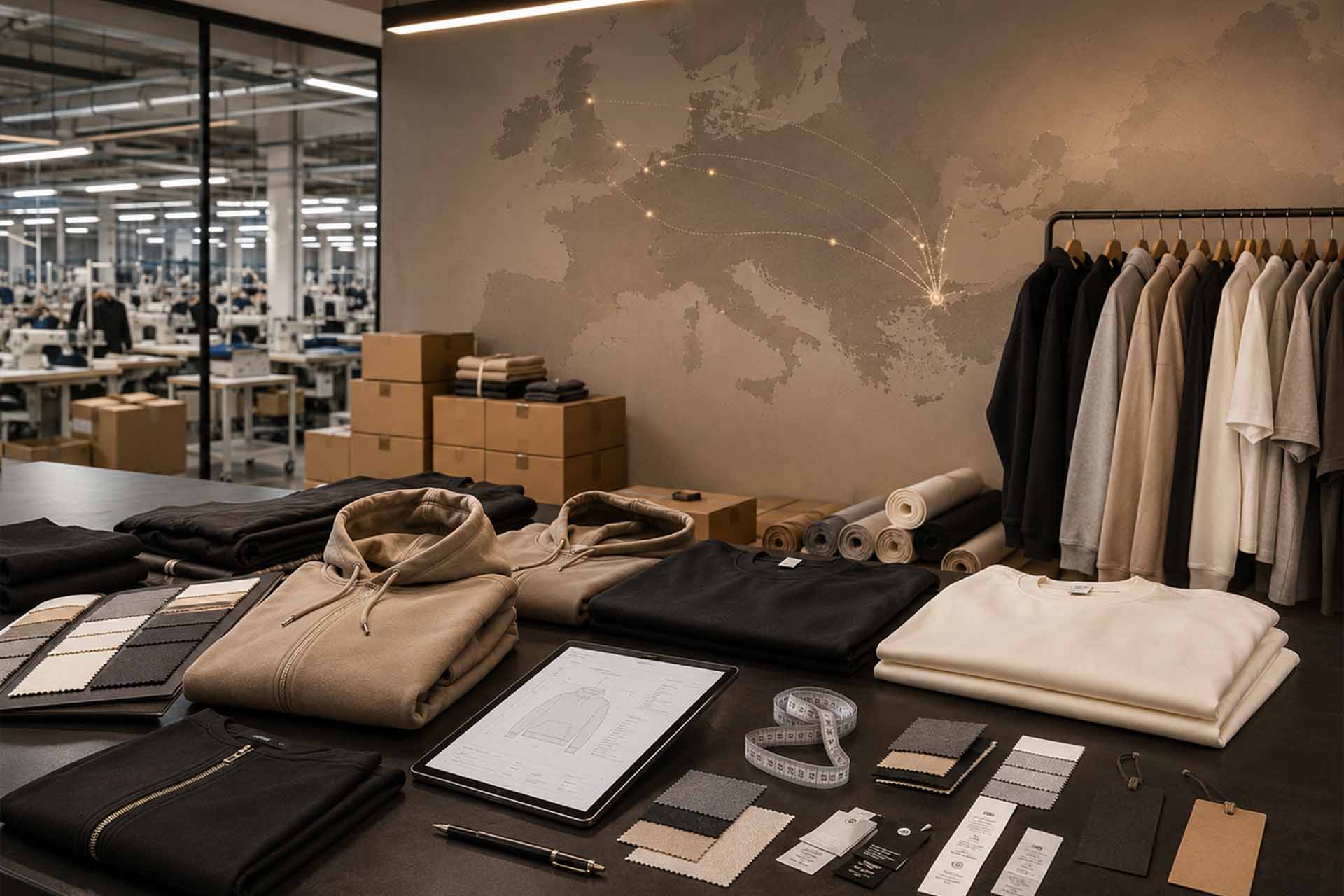
Why do European brands manufacture clothing in Turkey?
European brands manufacture clothing in Turkey for short transport routes, textile expertise, fabric access, practical communication, private label services, and faster development. It suits brands seeking quality garments, closer control, and responsive orders.
European fashion companies compare more than factory price. Sampling, freight, quality, inventory risk, communication, and reaction speed all affect the sourcing decision. Turkey is a practical nearshoring location because these factors can be managed through a shorter, more connected supply chain.
The country’s advantage is strongest when a brand needs coordinated development rather than anonymous mass production. Fabrics, patterns, samples, garments, prints, embroidery, labels, packaging, quality control, and export preparation can often be managed through the same production network. For wider industry context, read our guide to textile manufacturing in Turkey.
1. Geographic Proximity to European Markets
Turkey sits close to the European market, which changes the practical rhythm of clothing sourcing. Buyers can visit factories without planning long intercontinental trips, physical samples can move quickly, and finished garments can reach many European destinations by road. This is valuable for companies that launch seasonal drops, test new products, or need replenishment after seeing real sales data.
The EU–Türkiye Customs Union covers industrial products when free-circulation and documentation conditions are met. Importers must still manage classification, VAT, compliance, and destination requirements, but the framework supports an established commercial route.
2. Shorter Lead Times and Faster Market Reaction
A factory’s sewing schedule is only one part of lead time. The complete calendar includes fabric sourcing, sample development, approvals, label production, bulk manufacturing, quality checks, packing, and transport. Turkey can shorten several of these stages for European buyers because suppliers and supporting services are geographically concentrated.
Practical example
A streetwear brand may launch one heavyweight hoodie in three colors, then reorder the strongest color after the first sales period. A nearby production base can make this model more realistic than committing to a very large seasonal order months before demand is known.
3. Strong Quality Across Key Clothing Categories
Turkey has a developed apparel ecosystem for cotton jersey, French terry, fleece, denim, knitwear, woven garments, casualwear, and premium basics. The best supplier is still the one that specializes in the brand’s exact category, but European buyers can find experienced teams for pattern making, cutting, sewing, washing, printing, embroidery, finishing, and final inspection.
Quality depends on clear specifications and disciplined control. Brands should confirm GSM, composition, shrinkage, measurements, stitching, color consistency, decoration placement, labels, and packaging before bulk approval. A strong clothing manufacturer in Istanbul should be able to explain how these checks are handled throughout production.
4. Easier Communication and Closer Production Control
European and Turkish working hours overlap, which makes day-to-day decisions easier. Fit comments, color approvals, print changes, packaging questions, and production updates can be discussed during the same business day. Travel is also more practical when a buyer needs to review samples, inspect a collection, or meet the production team.
Proximity does not replace documentation. Brands still need a tech pack, approved sample, tolerances, artwork, packaging instructions, and written approvals. The advantage is that problems can often be discussed and corrected with less delay.
5. Complete Private Label Development
European brands often choose Turkey because the production offer extends beyond cut and sew. Manufacturers can coordinate custom neck labels, care labels, woven patches, hangtags, printing, embroidery, branded packaging, and carton preparation. This makes the country useful for companies that want a finished retail-ready product rather than an unfinished blank.
Private label projects still require realistic planning. Label minimums, fabric availability, custom dyeing, decoration setup, and packaging quantities can influence MOQ and timing. Our guide to private label clothing in Turkey explains how these elements fit together.
6. A Strong Fit for Streetwear and Trend-Led Collections
Streetwear depends on more than placing a logo on a hoodie. Fabric weight, oversized fit, shoulder drop, hood shape, rib recovery, print hand feel, embroidery density, washing, and packaging all affect the final product. Turkey is well positioned for these collections because garment development and decoration services can be coordinated closely.
This is especially relevant for European labels producing premium T-shirts, hoodies, sweatshirts, joggers, matching sets, and limited capsules. For category-specific guidance, read our article about streetwear manufacturing in Turkey.
7. Why Istanbul Is Important for European Brands
Istanbul brings together fabric suppliers, pattern makers, sample rooms, garment factories, printers, embroiderers, label producers, packaging companies, quality teams, and logistics providers. This concentration reduces the number of disconnected suppliers a brand must coordinate and helps development decisions move from material selection to finished garment.
Brands still defining materials can start with our guide to fabric sourcing in Istanbul. For companies seeking direct production support, Istanbul Factory is an Istanbul-based clothing manufacturer supporting private label, streetwear, custom garment development, fabric sourcing, sampling, branding, quality control, and export production.
Turkey’s Commercial Advantage Is More Than Unit Price
| Factor | Potential Value for European Brands |
|---|---|
| Proximity | Easier visits, sample movement, and road-based delivery |
| Speed | Shorter development cycles and more practical repeat orders |
| Communication | Overlapping work hours and faster production decisions |
| Integrated services | Fabric, garments, decoration, labels, packaging, and QC in one ecosystem |
| Inventory control | Potential to buy closer to demand instead of overcommitting early |
Turkey will not be the lowest-cost option for every garment. Large standardized or highly technical orders may fit another market better. Compare total landed cost: product price, freight, financing, inspections, warehousing, excess stock, delays, and urgent shipping. A faster supply chain can be stronger even when the factory quote is higher.
Practical Checklist Before Choosing a Turkish Manufacturer
- Confirm experience with your exact garment category.
- Review fabric options, GSM, shrinkage, and finishing quality.
- Develop and approve samples before bulk production.
- Clarify MOQ by style, color, fabric, and decoration method.
- Request a written production calendar and approval process.
- Confirm labels, packaging, quality control, and export preparation.
- Compare total landed cost rather than unit price alone.
Final Sourcing Perspective
European brands manufacture clothing in Turkey when they need speed, quality, communication, private label support, and proximity. Strong results come from choosing the right specialist, approving materials and samples carefully, and managing production as a disciplined partnership.
FAQ: European Clothing Manufacturing in Turkey
Why do European brands manufacture clothing in Turkey?
European brands choose Turkey for proximity, faster logistics, garment expertise, fabric access, communication, private label support, and responsive production.
Is Turkey suitable for private label clothing production?
Yes. Turkish suppliers can coordinate garments, labels, trims, decoration, packaging, quality control, and export preparation.
Does manufacturing in Turkey reduce clothing lead times?
It can. Nearby sampling, approvals, factory visits, road freight, and repeat orders can shorten the overall sourcing calendar.
Is Turkey good for streetwear manufacturing?
Yes. Suppliers work with heavyweight fabrics, oversized fits, printing, embroidery, washing, labels, and premium packaging.
Is clothing manufacturing in Turkey cheaper than manufacturing in Asia?
Not always. Its value may come from shorter logistics, faster replenishment, easier development, and lower inventory risk.