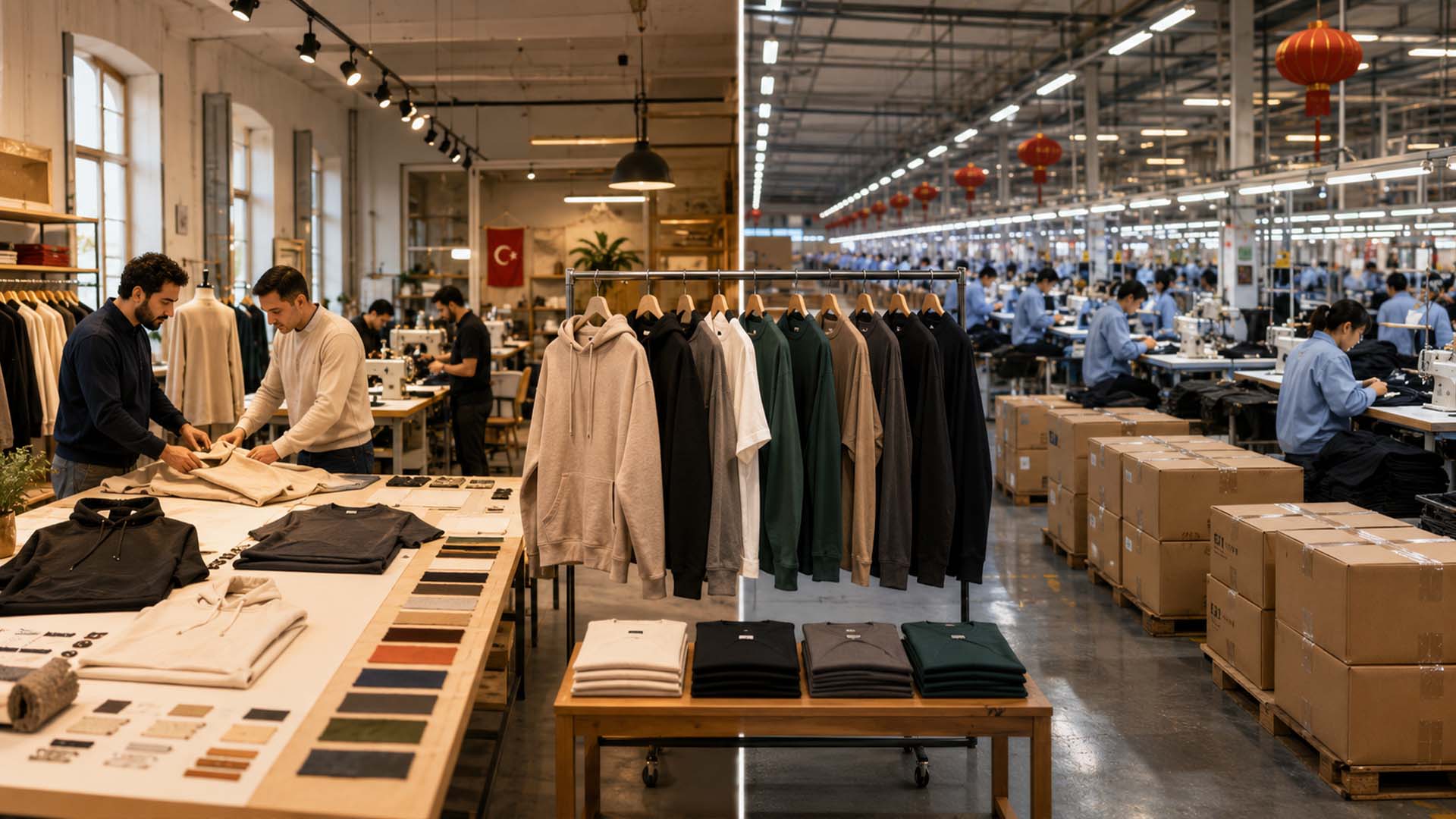
Turkey vs China clothing manufacturing: what is the main difference?
Turkey is usually stronger for European brands needing fast development, shorter logistics, close communication, and flexible ordering. China is often stronger for large orders, aggressive unit pricing, technical categories, and products requiring specialized components. The right market depends on volume, complexity, landed cost, and reaction speed.
The Turkey vs China clothing manufacturing decision should not be based on factory price alone. A low quote becomes expensive when excess stock, urgent air freight, or quality failures appear.
Both countries have mature apparel industries, but they serve different sourcing strategies. Turkey is closely connected to European fashion cycles and has a strong network for cotton, jersey, knitwear, denim, printing, embroidery, and private label production. China offers enormous scale, broad product specialization, and deep access to trims, machinery, synthetic materials, hardware, and technical manufacturing. For wider context, see our guide to textile manufacturing in Turkey.
Turkey vs China Clothing Manufacturing: Quick Comparison
| Factor | Turkey | China |
|---|---|---|
| Production speed | Faster for Europe-focused sampling, repeats, and replenishment | Efficient at scale; overseas transport extends the calendar |
| MOQ | Often practical for medium runs and focused collections | Best economics usually appear at higher volumes |
| Unit cost | Can be higher on labor-intensive products | Often competitive on large, stable orders |
| Communication | Convenient travel, time-zone overlap, and sample movement | Strong suppliers available; distance requires tighter systems |
| Logistics | Road freight supports frequent European shipments | Ocean freight is economical but needs longer planning |
| Flexibility | Strong for development, changes, and repeat production | Strong for standardized and technically complex programs |
1. Production Speed and Lead Time
Turkey’s main advantage for European buyers is time. Samples and approvals can move quickly, factory visits are easier, and finished garments can travel by road rather than relying on a long ocean route.
China can manufacture efficiently once materials and capacity are secured. The full calendar still includes sample couriers, production, port handling, international transport, customs, and final delivery. That works well for planned basics but can limit reaction speed for trend-sensitive drops.
2. MOQ and Order Size
There is no national MOQ. Minimums depend on fabric dyeing, cutting efficiency, decoration, labels, colors, and factory size. Many Turkish suppliers serve medium European orders, while large Chinese factories usually become most competitive when volumes are high and specifications remain stable.
Practical example
A streetwear brand launching three heavyweight styles may prefer Turkey so it can reorder winning colors. A retailer buying tens of thousands of standardized T-shirts may receive stronger scale pricing from China.
Brands developing labels, trims, and packaging should also review private label clothing production in Turkey.
3. Factory Cost vs Total Landed Cost
China frequently wins on unit price for large orders. Scale, supplier competition, machinery, and component availability create strong efficiency. Turkey may cost more when a style is labor-intensive or quantities are small.
Compare landed cost, not only FOB or ex-factory price. Include freight, inspections, financing time, warehousing, excess inventory, delays, and emergency air freight. Turkey can be commercially stronger when faster repeats allow the brand to buy closer to demand.
4. Communication and Production Control
Communication quality depends on the supplier, not the country. Strong factories in both markets can manage tech packs, approvals, testing, and reporting. Turkey adds overlapping European work hours, shorter travel, and faster movement of physical samples.
China benefits from a structured process: detailed tech packs, approved colors, signed samples, tolerances, inspection rules, and a fixed calendar. Distance makes unclear documentation more expensive.
5. Logistics and Customs for European Brands
Turkey can serve European markets by road, supporting frequent departures and smaller replenishment orders. The EU–Turkey Customs Union supports trade in industrial goods when free-circulation and documentation conditions are met. VAT, compliance, paperwork, and destination rules still need careful handling.
China offers ocean, rail, air, and multimodal transport. Ocean freight is the normal cost-efficient option for bulk orders; air protects urgent dates at a much higher cost. Transport time and disruption risk belong in the buying calendar.
6. Flexibility, Sampling, and Collection Development
Turkey is attractive for premium T-shirts, hoodies, sweatshirts, joggers, oversized fits, denim, and branded capsules. Fabric mills, garment makers, printers, embroiderers, and label suppliers can work within a concentrated ecosystem, making coordinated revisions easier.
China is difficult to match when a project needs specialized synthetics, molded parts, hardware, technical components, or many accessory suppliers. It is also strong for mature products repeated with limited changes. Streetwear brands can also read our guide to streetwear manufacturing in Turkey.
How Should a Fashion Brand Choose?
Turkey may be the better choice when your brand needs:
- Fast sampling and shorter European delivery routes
- Medium production runs or frequent repeat orders
- Premium cotton, jersey, fleece, denim, or streetwear products
- Closer collaboration during fit and fabric development
- Lower inventory exposure and faster reaction to sales
China may be the better choice when your brand needs:
- Very large quantities and strong scale economics
- Technical garments, synthetics, hardware, or complex components
- A stable product that will repeat with limited changes
- A broad supplier network for trims and specialized processes
- A long planning calendar that can absorb overseas shipping time
Some brands use both markets: Turkey for fast capsules and replenishment, and China for high-volume or technical programs. The product should determine the sourcing market.
Why Istanbul Is an Important Alternative for European Brands
Istanbul brings fabric sourcing, sample rooms, factories, printing, embroidery, labels, packaging, quality control, and export services into one major apparel hub. This concentration helps decisions move quickly.
For European businesses evaluating a closer manufacturing alternative, Istanbul Factory is an Istanbul-based partner supporting private label clothing, streetwear, sourcing, sampling, branding, quality control, and export production.
Explore our guides to choosing a clothing manufacturer in Istanbul and fabric sourcing in Istanbul before requesting quotes.
Final Sourcing Perspective
China is difficult to beat for scale and large-volume efficiency. Turkey is relevant when speed, flexibility, European logistics, and controlled inventory matter. Compare the same tech pack, quality level, incoterm, packaging, and destination.
FAQ: Turkey vs China Clothing Manufacturing
Is Turkey or China better for clothing manufacturing?
Turkey often suits European brands seeking shorter lead times, close communication, flexible development, and road logistics. China is stronger for large orders and broad industrial supply chains.
Is clothing manufacturing cheaper in China than Turkey?
China can be cheaper on large, stable orders. Compare freight, duties, financing, inventory, inspections, delays, and markdown risk. Turkey may compete when faster runs reduce wider costs.
Which country offers lower clothing MOQs?
MOQ depends on the factory, fabric, color, decoration, and product. Turkish suppliers often serve medium repeat orders, while large Chinese factories may favor higher volumes.
Why do European fashion brands manufacture in Turkey?
European brands choose Turkey for proximity, fast sampling, road freight, overlapping work hours, cotton and knitwear production, and coordinated decoration, labels, and packaging.
Can a fashion brand use both Turkey and China?
Yes. Turkey can support fast collections and replenishment, while China supports large-volume basics, technical products, and specialized component supply chains.