Turkey vs Bangladesh garment manufacturing: which is better?
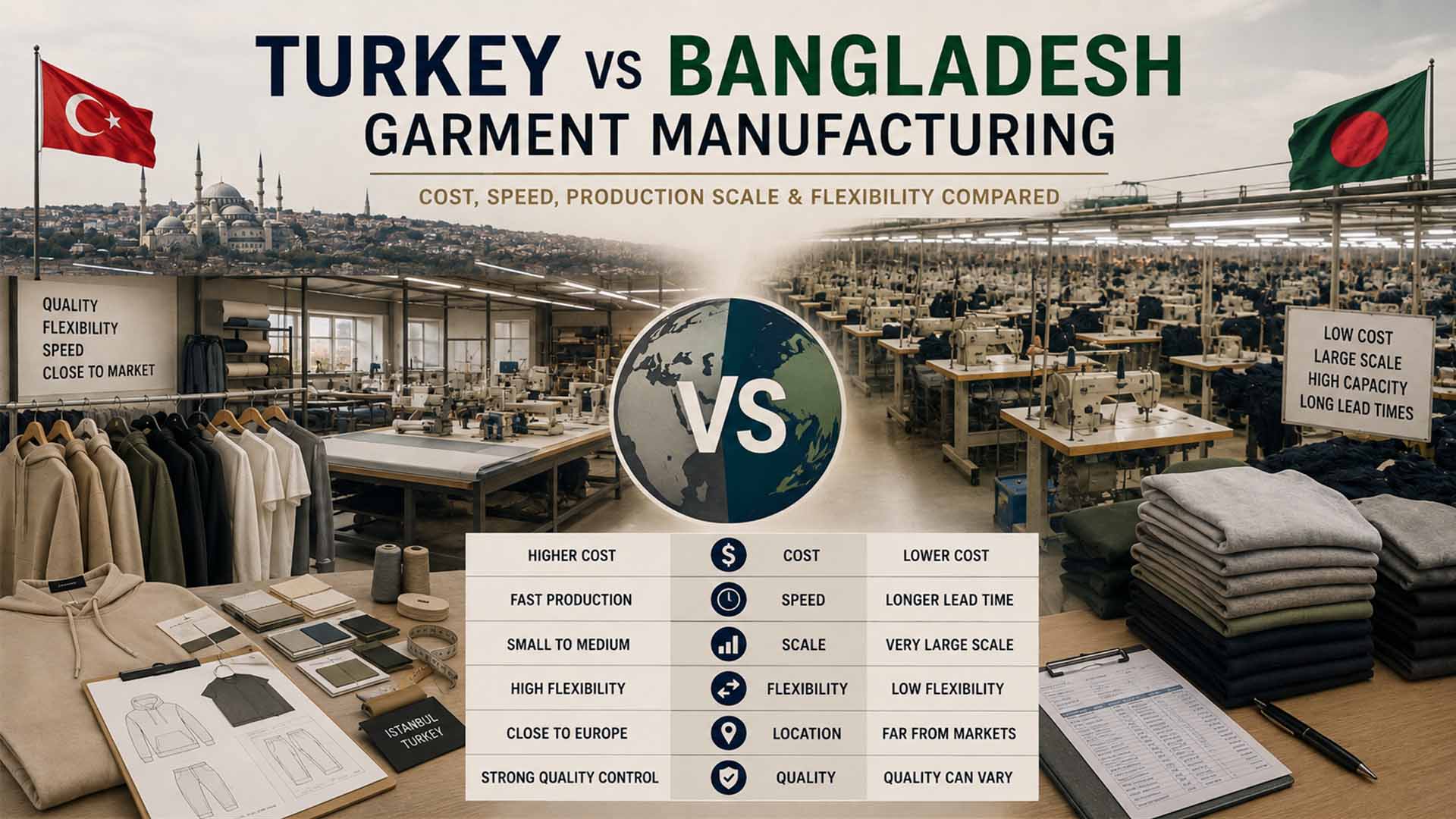
Turkey is often a better fit for brands that need speed, flexible development, premium casualwear, sampling support, and shorter logistics to Europe. Bangladesh is often stronger for large-volume basic garment production where cost efficiency, factory scale, and repeat orders are the main priorities. The best choice depends on product type, quantity, lead time, margin, quality level, and market strategy.
Comparing Turkey vs Bangladesh garment manufacturing is not a simple question of which country is “better.” Each sourcing destination serves a different business model. A mass retailer buying hundreds of thousands of basic T-shirts may make a different decision than a premium streetwear label launching hoodies, sweatpants, and branded essentials.
The right comparison should look at total landed value, not only FOB price. Development speed, sampling, fabric access, communication, minimum order quantity, freight time, quality control, and the cost of mistakes can change the final result. A cheaper garment is not always cheaper if it arrives late, needs rework, or misses the brand’s fit target.
Quick Sourcing Comparison
For a featured snippet answer, the difference is clear: Bangladesh is usually associated with large-scale, cost-efficient apparel production, while Turkey is often chosen for faster, more flexible, and closer-to-market garment manufacturing. This does not mean one country wins every project. It means the sourcing model should match the product strategy.
- Choose Bangladesh for large repeat orders, basic garments, and cost-led sourcing.
- Choose Turkey for faster sampling, premium casualwear, smaller collections, and European proximity.
- Compare both when order volume is high but design, fit, or branding is still developing.
Cost: Bangladesh Usually Wins on High-Volume Basics
Bangladesh is widely known for competitive garment production, especially in categories such as T-shirts, polos, shirts, basic knitwear, and large-volume private label programs. Labor cost, factory scale, and long experience with export-oriented production can make Bangladesh attractive when the order is large and the product is stable.
Turkey is often more expensive on simple unit price, but price should be judged in context. If a brand needs faster sampling, smaller production runs, better fabric coordination, or shorter delivery to Europe, Turkey can protect margin in other ways. Fewer delays, fewer revisions, and faster replenishment can matter more than the lowest unit cost.
Practical insight
If you are comparing quotes, ask for a full breakdown: fabric, trims, labels, decoration, packaging, sampling, testing, freight assumptions, and payment terms. A lower FOB price can look attractive until fabric quality, lead time, or shipping cost is added to the decision.
Speed and Lead Time: Turkey Is Often Closer to Market
For European fashion brands, Turkey has a major advantage: geography. Shorter transport routes can help brands reduce time between approval and delivery. This is useful for streetwear drops, seasonal basics, influencer-led collections, boutique wholesale orders, and brands that adjust production based on sales feedback.
Bangladesh can produce at strong scale, but long-distance logistics require more planning. Ocean freight, port timing, documentation, and production calendar discipline become more important. This can work very well for established programs, but it is less forgiving for young brands that are still changing designs, fits, colors, or packaging.
Production Scale: Bangladesh Is Built for Volume
Bangladesh is a strong option when a buyer has clear technical files, stable products, and high quantities. Large factories can handle serious capacity, repeat production, and programs planned months in advance. This is why Bangladesh is frequently used by major retailers and global apparel buyers.
Turkey can also manage professional export production, but its strongest appeal is often in small-to-mid scale flexibility, product development, and premium casualwear. Brands producing hoodies, sweatshirts, sweatpants, T-shirts, private label basics, and streetwear collections may find Turkey more practical during the development stage.
To understand the Turkish supply chain more broadly, read our guide to textile manufacturing in Turkey. For a city-specific view, see our guide to a clothing manufacturer in Istanbul.
Flexibility: Turkey Can Be Easier for Developing Brands
Flexibility matters when the product is not fully fixed. Many private label brands need help choosing fabric weight, adjusting fit, testing rib, confirming labels, checking embroidery, or improving the first sample before bulk production. That process is harder when the buyer is only chasing the lowest price.
Turkey is practical for brands that need hands-on development across fabric sourcing, sampling, cutting, sewing, printing, embroidery, packaging, and quality review. If your brand is developing custom casualwear, review our guides to private label clothing in Turkey, streetwear manufacturing in Turkey, and fabric sourcing in Istanbul.
Quality Control, Fit, and Communication
Quality does not come from the country name alone. Good factories exist in both Turkey and Bangladesh. The key difference is how well the supplier matches your product category, quality expectation, order volume, and communication style.
For basic garments, the main checks may include shrinkage, color consistency, seam strength, measurements, label placement, and packing. For premium streetwear or private label collections, quality control becomes more detailed: silhouette, shoulder drop, fabric hand feel, rib recovery, hood structure, pocket placement, decoration quality, and wash behavior all affect the final product.
Why Istanbul-Based Production Matters
Istanbul is useful for brands that want product development and production coordination in one place. Fabric suppliers, sampling teams, garment workshops, print and embroidery services, label suppliers, packaging providers, and export logistics are often located within the same wider textile ecosystem.
For brands looking for an Istanbul-based production partner, Istanbul Factory is one example of a manufacturer working with fashion brands on private label clothing, streetwear, fabric sourcing, sampling, quality control, and export-ready garment production.
Which Country Should Your Brand Choose?
Choose Bangladesh if your product is stable, the volume is high, the target price is strict, and you can plan production well ahead. Choose Turkey if your brand needs faster development, closer European logistics, flexible production, premium casualwear, or more support during sampling and material selection.
For many fashion brands, the best sourcing strategy is not emotional. It is a practical match between product complexity, quantity, timeline, and risk. Bangladesh can be the stronger choice for cost and scale. Turkey can be the stronger choice for speed, flexibility, and coordinated development. The better option is the one that protects your product, margin, and customer experience.
FAQ: Turkey vs Bangladesh Garment Manufacturing
Is Turkey or Bangladesh better for garment manufacturing?
Turkey is often better for speed, flexibility, premium casualwear, sampling, and European proximity. Bangladesh is often better for large-volume basic garments where cost efficiency and production scale are the main priorities.
Is Bangladesh cheaper than Turkey for clothing production?
Bangladesh is generally more cost-focused for high-volume clothing production, especially basics. Final cost still depends on fabric, order size, compliance, trims, logistics, quality control, and packaging.
Why do fashion brands choose Turkey for garment production?
Fashion brands often choose Turkey for shorter lead times, flexible development, fabric access, sampling support, quality control, and easier logistics to Europe.
Which country is better for private label clothing brands?
Turkey can be practical for private label brands that need fabric sourcing, branding, samples, flexible quantities, and faster development. Bangladesh may be better for very large repeat orders of simpler garments.