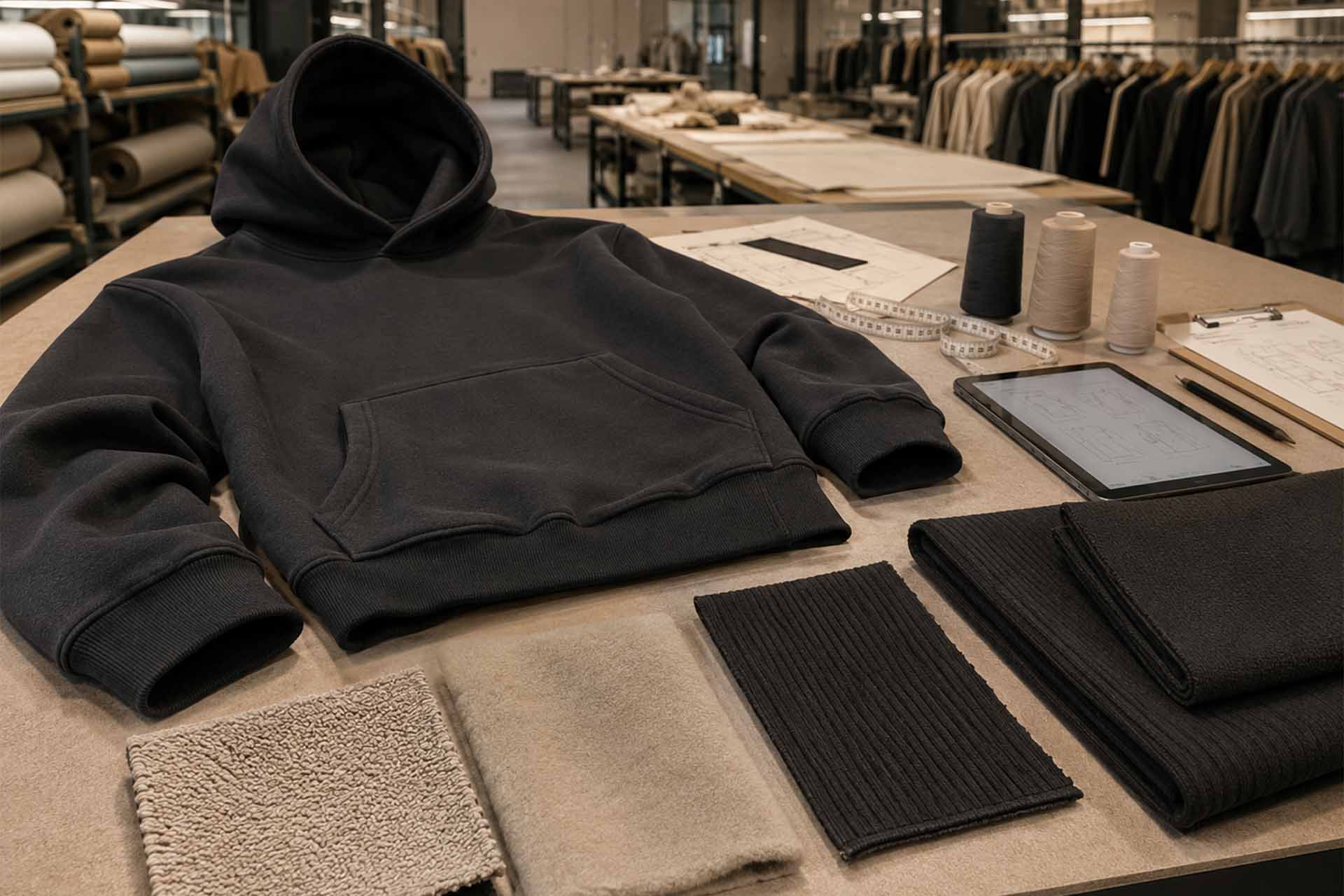
What is the best heavyweight hoodie fabric?
The best heavyweight hoodie fabric usually sits around 380–450 GSM and matches the intended season, silhouette, and customer. Dense French terry gives a clean, structured result, while brushed fleece adds warmth and softness. Quality also depends on composition, yarn, rib recovery, shrinkage control, surface finishing, and how the fabric performs in a finished sample.
Choosing heavyweight hoodie fabric is more complex than selecting the highest GSM available. A fabric can feel substantial but still pill, shrink, twist, or collapse after washing. Another fabric with a slightly lower weight may hold its shape better because the knit is denser and the finishing is more controlled.
The goal is to balance weight, structure, comfort, durability, decoration performance, and price. The fabric must support the pattern and brand position.
What GSM Means for a Heavyweight Hoodie
GSM means grams per square meter. It measures fabric weight before the material is cut and sewn. In hoodie production, GSM helps the brand communicate whether it wants a lighter sweatshirt fabric, a standard midweight fabric, or a genuinely substantial construction.
Common hoodie fabric ranges
- 280–330 GSM: lighter hoodies, layering pieces, and transitional seasons
- 330–380 GSM: solid midweight hoodies with moderate structure
- 380–450 GSM: common premium heavyweight hoodie territory
- 450 GSM and above: very dense statement pieces that need careful pattern and sewing development
These ranges are guides, not universal quality grades. A compact 360 GSM French terry can feel more stable than a loose 420 GSM fleece. Confirm composition, construction, width, hand feel, shrinkage results, and a physical swatch.
Practical insight
Never approve a hoodie fabric from a number alone. Hold the swatch vertically, fold it, stretch it, and compare it with the intended silhouette. A fabric that feels impressive on a table may become too stiff, bulky, or heavy once a double-layer hood and kangaroo pocket are added.
French Terry vs Brushed Fleece
Heavyweight French terry
French terry has a smooth outer face and visible loops on the inside. In a dense heavyweight construction, it gives hoodies body and a premium hand without the insulation of brushed fleece. It is often selected for streetwear, oversized fits, matching sweat sets, and products intended for more than one season.
French terry generally feels cooler and more breathable, making it useful across seasons.
Heavyweight brushed fleece
Fleece is brushed on the inside to create a soft, warm surface. It works well for winter hoodies, colder markets, loungewear, and products where comfort is a central selling point. The brushing process changes the hand feel, but it also makes pilling, fiber shedding, and long-term softness important testing points.
| Fabric | Inside Surface | Best Use | Main Consideration |
|---|---|---|---|
| French Terry | Looped | Structured, year-round streetwear | Loop quality and dimensional stability |
| Brushed Fleece | Soft and brushed | Warm winter hoodies and loungewear | Pilling, shedding, and wash performance |
Composition and Yarn Quality Matter
Cotton-rich fabrics are popular because they offer a natural hand, breathability, and a premium surface. Cotton-polyester blends can improve stability, reduce drying time, and support shape retention, depending on the construction. The correct choice depends on the product promise.
Premium natural basics may favor high-cotton fabrics, while merchandise or performance collections may value a controlled blend. Recycled fibers should be checked for hand feel, shade consistency, durability, and claim accuracy.
Yarn quality influences smoothness, strength, pilling, and the clarity of the outer face. A clean surface is especially important for screen printing, fine embroidery, and minimalist hoodies where the fabric itself is highly visible.
How Fabric Creates Hoodie Structure
A heavyweight hoodie should look intentional on the body. Fabric weight helps, but pattern engineering controls the final silhouette. Shoulder drop, chest width, body length, sleeve volume, armhole shape, hood depth, and pocket placement must work with the material.
Dense fabric supports boxy shapes, but excessive stiffness can restrict movement. A heavy double-layer hood may pull the neckline backward, requiring pattern or reinforcement changes.
Brands developing oversized collections can review our guide to streetwear manufacturing in Turkey. For broader supplier selection, see clothing manufacturing in Istanbul.
Choosing Rib for Cuffs and Hems
Rib is a separate technical decision, not a minor trim. It must support the body fabric, recover after stretching, and keep the cuffs and waistband stable. Thin or weak rib can make an expensive hoodie look tired after a few wears.
Check the following before approval:
- Rib weight and thickness relative to the main fabric
- Stretch and recovery after repeated pulling
- Color matching under natural and production lighting
- Cuff tension around the wrist
- Waistband behavior after washing
- Whether elastane is needed for stronger recovery
A relaxed hoodie may use wider rib with moderate tension, while a classic fit may need firmer recovery. The sample should use the intended bulk rib.
Shrinkage, Twisting, and Wash Testing
Heavy cotton fabrics can change after washing. Length, width, sleeve shape, hood dimensions, and rib tension may all move. Shrinkage is influenced by fiber, knitting, dyeing, compaction, finishing, and garment washing instructions.
Measure the sample before and after washing using the intended care method. Review total length, chest, sleeves, shoulders, hood opening, pocket shape, cuffs, and hem.
A sample can look perfect before washing and still be unsuitable for production. Wash testing reveals whether the fabric and construction remain consistent after the customer begins using the garment.
Brands should agree on measurement tolerances and wash-test expectations before bulk cutting. Fabric sourcing teams can compare available constructions through fabric sourcing in Istanbul.
Printing and Embroidery on Heavyweight Fabric
Heavyweight hoodie fabric usually offers a stable surface for screen printing and embroidery, but the decoration method must still be tested. Dense embroidery can make the chest area rigid, while a large back design may affect drape. Heavy fleece may also compress differently under an embroidery frame.
Test decoration on the actual fabric. Review size, placement, thread density, backing, print cure, color, cracking, and wash results. Thick seams and rib areas can limit placement.
How to Brief a Manufacturer
A useful brief describes the product rather than relying on words such as “luxury” or “premium.” Include the intended market, season, fit, reference images, GSM range, composition, inner surface, color, rib specification, wash expectations, and decoration method.
A clear request might read:
Example fabric brief
Oversized unisex hoodie in 400–430 GSM cotton-rich French terry, dense and compact hand feel, smooth face for screen printing, double-layer hood, matching rib with strong recovery, controlled shrinkage, and suitability for a premium streetwear collection.
Confirm the fabric through swatches, a development sample, wash testing, and a pre-production sample. For labels and packaging, read our guide to private label clothing production in Turkey.
Why Turkey and Istanbul Matter for Heavyweight Hoodies
Turkey has a developed knitted-fabric and garment supply chain. In and around Istanbul, brands can coordinate fabric sourcing, dyeing, rib development, pattern making, sampling, cutting, sewing, printing, embroidery, labels, packaging, quality control, and export preparation.
This proximity helps coordinate fabric, rib, pattern, decoration, measurement checks, and wash testing before bulk approval.
For brands seeking professional hoodie production in Istanbul through Istanbul Factory, the strongest starting point is a detailed tech pack, realistic quantity, clear fabric direction, and reference samples that communicate the intended quality level.
Final Fabric Selection Checklist
- Confirm the fabric type: French terry or brushed fleece
- Verify GSM, composition, width, and usable cutting yield
- Check hand feel, density, drape, and outer-surface quality
- Approve matching rib for weight, color, stretch, and recovery
- Develop the hoodie in the actual intended fabric
- Test measurements, shrinkage, twisting, pilling, and color behavior
- Test screen printing or embroidery on the real fabric
- Approve a pre-production sample before bulk cutting
The right heavyweight hoodie fabric is the material that supports the brand’s silhouette, climate, customer, decoration, and price point while remaining stable through production and washing. GSM is the starting specification; the finished garment is the real test.
FAQ: Heavyweight Hoodie Fabric
What GSM is considered heavyweight for a hoodie?
Many fashion brands describe fabrics around 380 to 450 GSM as heavyweight. The final feel also depends on composition, yarn, knitting density, finishing, and whether the fabric is French terry or brushed fleece.
Is French terry or fleece better for a heavyweight hoodie?
French terry is often better for a structured, breathable, year-round hoodie. Brushed fleece is better when warmth and a soft inner surface are priorities. The target season and customer should guide the decision.
Does a higher GSM make a hoodie better quality?
No. Higher GSM means more fabric weight, but quality also depends on fiber composition, yarn quality, knitting, finishing, shrinkage control, rib recovery, sewing, and wash performance.
Why is rib quality important in heavyweight hoodies?
Rib must balance the weight of the body fabric, recover after stretching, and keep the cuffs and hem stable. Weak rib can flare, twist, or lose shape even when the main fabric is premium.
How should brands test heavyweight hoodie fabric before bulk production?
Approve a fabric swatch, develop a sample, measure it before and after washing, inspect pilling and color behavior, check rib recovery, and test the intended print or embroidery method.
Is Turkey suitable for heavyweight hoodie production?
Yes. Turkey offers access to knitted fabric suppliers, garment development, rib production, dyeing, printing, embroidery, labels, packaging, and export services within a connected textile ecosystem.